

Rome Travel Guide 2026 — Colosseum, Vatican, Food & Where to Stay
There is no city on Earth quite like Rome. Nowhere else can you eat a cornetto at a bar that has been serving breakfast since the 1800s, walk past a 2,000-year-old aqueduct on the way to the supermarket, and then spend the afternoon in a museum whose collection spans three millennia. Rome rewards visitors who slow down: the city is not a checklist of monuments but a living, layered place where the ancient, the baroque, and the exuberantly modern exist side by side in a way that makes no sense and yet feels completely natural.
This 2026 guide covers everything — from the Colosseum and Vatican to neighbourhood trattorias, rooftop aperitivo bars, and the day trips that most visitors miss. Whether you have three days or a full week, Rome will fill every hour.
🇮🇹 Rome at a Glance
- 📍 Location: Lazio region, central Italy — capital city
- ✈️ Airports: Fiumicino (FCO) — main · Ciampino (CIA) — budget airlines
- 🌡️ Best months: April–May, September–October
- 💶 Currency: Euro (€)
- 🗣️ Language: Italian — English spoken in tourist areas
- ⏱️ Recommended stay: 4–6 days minimum
- 🚇 Getting around: Walking, Metro, tram, taxi
- 🏨 Book accommodation: Search Rome hotels on Booking.com →
When to Visit Rome
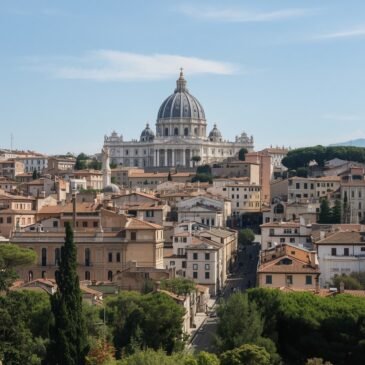
Getting to Rome
✈️ By Flight
Rome has two airports. Fiumicino (FCO) is the main international airport — 30km from the city, served by all major carriers including Alitalia/ITA Airways, British Airways, Lufthansa, Air France, and American Airlines. The Leonardo Express train connects Fiumicino to Roma Termini in 32 minutes (€14). Ciampino (CIA) is the budget-carrier airport — closer to the city but served mainly by Ryanair and easyJet, with bus transfers taking 40–60 minutes to the centre (€6–7).
🚂 By Train
Rome’s central station, Roma Termini, connects directly to Florence (1.5 hrs by high-speed), Naples (1 hr), Venice (3.5 hrs), and Milan (3 hrs). If you’re combining Rome with other Italian cities, train travel is faster, more scenic, and often cheaper than flying when booked in advance.
Getting Around Rome
🚶 Walking
Rome’s historic centre is compact and best explored on foot. The Colosseum, Roman Forum, Pantheon, Piazza Navona, Campo de’ Fiori, Trastevere, and the Trevi Fountain are all within a 3km radius. Wear comfortable shoes — Rome’s cobblestones are relentless and beautiful in equal measure.
🚇 Metro & Tram
Rome’s Metro has only two main lines (A and B) — useful for getting between distant points but limited coverage of the historic centre. Line A serves Termini, Spanish Steps (Spagna), Vatican (Ottaviano), and Trastevere area. Line B serves Termini and Colosseum (Colosseo). Trams cover Trastevere and the Prati neighbourhood. Single ticket: €1.50 (valid 100 minutes). 48-hour pass: €6 · 72-hour pass: €8.25.
🚕 Taxi & Rideshare
Official Rome taxis are white with a “TAXI” sign — always use official taxis or the FREE NOW app to avoid tourist scams. Fixed fares apply from airports: FCO to centre €50 flat, CIA to centre €31 flat. Within the centre, most journeys cost €8–15. Avoid unlicensed drivers at Termini station who approach you offering rides — a common tourist trap.
Rome’s Neighbourhoods — Where to Spend Your Time
🏛️ Ancient Rome
Colosseo & Celio
The archaeological heart — Colosseum, Roman Forum, Palatine Hill, Circus Maximus. Best visited in the morning. Few restaurants worth eating at in this area — walk to Testaccio for food.
🍝 Best Food + Local Life
Testaccio
Rome’s old slaughterhouse district — now the city’s most authentic food neighbourhood. The covered market, traditional trattorias, the best supplì (fried rice balls) in Rome, and excellent wine bars. No tourist traps. Highly recommended for every meal.
✨ Most Beautiful
Centro Storico
Pantheon, Piazza Navona, Campo de’ Fiori, and the labyrinthine medieval streets between them. The most photogenic area in Rome — and the most expensive for eating. Best for morning walks and aperitivo; eat elsewhere.
🍷 Bohemian + Nightlife
Trastevere
Medieval neighbourhood across the Tiber — ivy-covered walls, excellent trattorias, aperitivo bars spilling onto cobblestone piazzas. Gets busy at night but has a genuinely local feel during the day. Best for dinner and evening drinks.
🛍️ Shopping + Elegant
Spanish Steps (Tridente)
The Trevi Fountain, Spanish Steps, Via Condotti (luxury shopping), and Villa Borghese park are all here. Beautiful for morning walks and the Borghese Gallery. Expensive restaurants — prioritise the gallery and piazzas over eating here.
⛪ Vatican Side
Prati
Residential neighbourhood beside the Vatican — wide boulevards, good mid-range restaurants, excellent gelaterias, and far fewer tourists than the centro storico. The best area to stay if the Vatican is a priority.
🎨 Hipster + Art
Pigneto & Ostiense
Rome’s emerging creative neighbourhood east of the centre — street art, independent bars, concerts, and the best aperitivo scene in the city outside Trastevere. Where young Romans actually eat and drink.
🌳 Parks + Luxury
Parioli
Upmarket residential neighbourhood north of Villa Borghese — excellent restaurants, quiet streets, and a genuinely Roman atmosphere away from the tourist trail. Best for a lunch splurge with local families.
Top Things to Do in Rome
Unmissable
🏟️ Colosseum, Roman Forum & Palatine Hill
The Colosseum is the most recognisable ancient building on Earth — and seeing it for the first time, at full scale, from street level, is genuinely overwhelming in the best possible way. The combined ticket includes the Roman Forum and Palatine Hill: the Forum was the civic and commercial heart of ancient Rome for over a thousand years, and Palatine Hill is where the emperors built their palaces overlooking it all. Allow a full morning for all three sites together.
Combined standard ticket · Valid 2 days
Walk on the original arena floor — the gladiators’ view
Below the arena floor — where gladiators and animals waited
- Opening hours: 09:00 until 1 hour before sunset — check seasonal times
- Book timed entry 2–4 weeks ahead in peak season — walk-up queues exceed 2 hours
- Best time: First entry at 09:00 or last entry 2 hours before closing
- The Forum is best explored with a guide or audio guide — context transforms the experience
Vatican
⛪ Vatican Museums, Sistine Chapel & St. Peter’s Basilica
The Vatican Museums contain one of the greatest art collections in human history — accumulated over 500 years by some of history’s most powerful patrons. The Sistine Chapel ceiling, painted by Michelangelo between 1508–1512, is one of the greatest artistic achievements ever made. The Gallery of Maps, the Raphael Rooms, and the ancient sculpture galleries are all extraordinary in their own right. St. Peter’s Basilica itself — the largest church in the world — is free to enter and architecturally staggering.
Standard entry · No time slot included
Free entry · Dome climb: €8 (stairs) or €10 (lift + stairs)
- Vatican Museums + Sistine Chapel: allow 3–4 hours minimum
- Book Vatican Museum tickets online well in advance — sells out weeks ahead in summer
- Early morning entry (08:00) is significantly less crowded
- Dress code: shoulders and knees covered for both the Basilica and Museums
- St. Peter’s dome climb: 551 steps (or 231 after the lift) — panoramic city view at the top
Free
⛲ Trevi Fountain, Pantheon & Piazza Navona
Three of Rome’s most iconic sights — all free to visit (though the Pantheon now charges €5 entry, justified by its extraordinary preservation). The Trevi Fountain is best visited at dawn (5:30–7:00am) before the crowds arrive — the golden morning light on the baroque facade and the sound of the water are genuinely magical without several thousand other visitors. The Pantheon is the best-preserved ancient building in Rome: 2,000 years old, with its original concrete dome still intact and open to the sky through the oculus at the centre. Piazza Navona, built on the site of an ancient stadium, is Rome’s most theatrical public space.
- Trevi Fountain: Free · Best at dawn · Throw a coin with your right hand over your left shoulder to ensure return to Rome
- Pantheon: €5 adults · Free first Sunday of month · Book time slot online to avoid queues
- Piazza Navona: Free · Bernini’s Fountain of the Four Rivers at the centre · Outdoor cafés (overpriced but worth one coffee)
Art
🎨 Borghese Gallery — Rome’s Hidden Masterpiece
The Galleria Borghese is the most underrated museum in Rome and one of the greatest collections of sculpture and painting in the world. Bernini’s marble sculptures here — particularly Apollo and Daphne, and the Rape of Persephone — are among the most technically extraordinary works ever created: marble carved to look like flowing hair, yielding flesh, and transparent fabric. The building itself is a jewel. Entry is strictly limited to 360 visitors per 2-hour slot — book at least 3–4 weeks ahead, because it genuinely sells out.
Timed entry · 2-hour slot · Must book in advance
Food
🍝 Rome Food Tour — The City’s Best Introduction
Rome’s food scene is one of the world’s great culinary cultures — built on exceptional ingredients, ancient techniques, and an almost religious devotion to simplicity. A guided food tour through Testaccio market, the local bakeries, and the neighbourhood’s trattorias introduces you to supplì (fried rice balls), cacio e pepe (the world’s most perfect pasta), artichokes alla giudia, porchetta sandwiches, and tiramisù in its Roman form — in a 3-hour morning that sets the template for every meal you eat in the city.
Day Trips from Rome
Most Important
🏛️ Pompeii & the Amalfi Coast (3 hrs)
The single greatest day trip from Rome. Pompeii was a thriving Roman city of 20,000 people buried under 6 metres of volcanic ash when Vesuvius erupted in 79 CE — and preserved almost perfectly for 1,700 years until excavation began in the 18th century. Walking its streets today, past intact bakeries, wine bars, election graffiti, and houses with their original frescoes, is one of the most extraordinary historical experiences in Europe. Combine with a drive along the Amalfi Coast for one of the most beautiful afternoons in Italy.
Closer
🏰 Tivoli — Hadrian’s Villa & Villa d’Este (1 hr)
The easiest and most rewarding half-day trip from Rome. The Emperor Hadrian built a vast private city-estate at Tivoli in the 2nd century CE — the ruins cover several kilometres and include reconstructed Greek temples, libraries, baths, and pleasure gardens. Villa d’Este nearby is a Renaissance masterpiece of water gardens — 500 fountains, nymphaea, and cascade terraces built into a steep hillside. Both are UNESCO World Heritage Sites and dramatically undervisited compared to anything inside Rome.
Florence
🎨 Florence by High-Speed Train (1.5 hrs)
Florence is 1.5 hours from Rome by Frecciarossa high-speed train — close enough for a day trip if you must, though 2 nights is better. The Uffizi Gallery (Botticelli’s Birth of Venus, Michelangelo’s Doni Tondo), the Florence Duomo with Brunelleschi’s dome, Michelangelo’s David at the Accademia, and one of Italy’s finest food markets make Florence an entirely separate destination that pairs naturally with Rome in a 10-day Italy itinerary.
Where to Stay in Rome
Most Atmospheric
Centro Storico — Best for Atmosphere & Walking Access
Walking distance to the Pantheon, Trevi Fountain, Piazza Navona, and Campo de’ Fiori. The most beautiful area to stay in Rome — staying here means you can walk to every major sight in the ancient centre. Premium prices but worth it for first-time visitors.
From €120/night · Boutique hotels from €200+
Best Vibe
Trastevere — Best for Evening Atmosphere & Local Feel
Medieval neighbourhood across the Tiber — cobblestones, ivy, excellent trattorias, and the most romantic evening atmosphere in Rome. 20-minute walk to the centro storico. The best area for travellers prioritising food, wine, and neighbourhood life over monument proximity.
From €90/night · Charming guesthouses from €130+
Best for Vatican Access
Prati — Best for Vatican Visitors & Mid-Range Value
Residential neighbourhood immediately north of the Vatican — 10-minute walk to St. Peter’s Square. Wide streets, excellent mid-range restaurants and gelaterias, and 15–20% cheaper than equivalent hotels in the centro storico. Very safe and clean area.
From €75/night · Good mid-range hotels from €120+
Best Budget
Termini Area — Best for Transport Hub & Budget Stays
The area around Roma Termini station has Rome’s best concentration of budget hotels and hostels — and direct Metro connections to both the Colosseum and Vatican. Not the most atmospheric area but practical, safe with some caution, and 30–50% cheaper than centro storico hotels.
From €40/night · Mid-range hotels from €80+
Where to Eat in Rome
Roman cuisine is built on a small number of iconic dishes done with absolute commitment — cacio e pepe, carbonara, amatriciana, coda alla vaccinara, supplì, and artichokes. Eating well in Rome means finding the trattorias where these dishes are made correctly, not the tourist-menu versions near the Colosseum.
| Restaurant / Place | Area | Vibe | Must Order |
|---|---|---|---|
| Tonnarello | Trastevere | Classic trattoria, lively, outdoor tables | Cacio e pepe, carbonara, carciofi |
| Flavio al Velavevodetto | Testaccio | Old Rome institution, built into the hill | Rigatoni all’amatriciana, coda alla vaccinara |
| Supplì Roma | Trastevere | Street food, queue and eat standing | Supplì al telefono (the Roman rice ball) |
| Da Enzo al 29 | Trastevere | Tiny, locals only feel, book weeks ahead | Pasta e ceci, artichokes alla giudia |
| Baccano | Tridente | Brasserie, long hours, good for solo diners | Aperitivo cicchetti, pasta, excellent wine list |
| Giolitti | Centro Storico | Legendary gelateria since 1900 | Pistachio and nocciola gelato, always |
| Il Sorpasso | Prati | All-day café-bar, excellent aperitivo | Aperol spritz with cicchetti buffet at 18:00 |
| Pizzarium | Prati | Bonci’s famous pizza al taglio, queue outside | Whichever topping looks best that day |
Suggested 5-Day Rome Itinerary
Day 1 — Ancient Rome
Early Colosseum entry (09:00, pre-booked). Roman Forum and Palatine Hill through mid-morning. Lunch in Testaccio. Afternoon at the Circus Maximus and Aventine Hill (see the Knights of Malta keyhole view of St. Peter’s dome). Dinner in Testaccio neighbourhood.
Day 2 — Vatican Day
Vatican Museums 08:00 opening (pre-booked, skip-the-line). Sistine Chapel before the crowds peak. St. Peter’s Basilica and dome climb (11:00–12:00). Lunch in Prati. Castel Sant’Angelo in the afternoon. Aperitivo at Il Sorpasso. Dinner in Trastevere.
Day 3 — Centro Storico & Art
Dawn walk to Trevi Fountain (05:30–06:30 — magical without crowds). Breakfast at a local bar. Borghese Gallery (pre-booked 09:00 slot). Villa Borghese park walk. Afternoon: Pantheon, Piazza Navona, Campo de’ Fiori. Dinner at Da Enzo al 29 in Trastevere (book in advance).
Day 4 — Day Trip (Pompeii or Tivoli)
Full-day tour to Pompeii (most dramatic) or half-day to Tivoli (closer, easier). Return for evening aperitivo in Pigneto or Ostiense neighbourhood — the most authentically Roman evening experience in the city.
Day 5 — Markets, Gelato & Final Wandering
Morning food tour or Testaccio market. Spanish Steps and Via Condotti window shopping. Giolitti for gelato. Final afternoon wandering the streets between the Pantheon and Campo de’ Fiori with no agenda — Rome’s greatest reward for those who allow it.
Book Your Rome Trip
✈️ Flights to Rome (FCO / CIA)
Compare prices across all airlines — direct flights from most European cities year-round, from North America and beyond.
🏨 Hotels in Rome
800+ properties across all neighbourhoods and budgets — from €40/night budget options near Termini to €400+/night boutique hotels in the centro storico.
🎟️ Skip-the-Line Tickets & Tours
Colosseum skip-the-line, Vatican Museums early entry, Borghese Gallery timed tickets, food tours, and Pompeii day trips — all bookable with free cancellation.
🚂 Train Tickets from Rome
High-speed trains to Florence (1.5 hrs), Naples (1 hr), Venice (3.5 hrs), and Milan (3 hrs). Book in advance for best prices on Trenitalia and Italo.
🚗 Car Rental in Rome
Essential for day trips to Pompeii, the Amalfi Coast, Tivoli, and Orvieto. Compare pickup at FCO airport or central Rome locations.
FAQ — Rome Travel 2026
How many days do you need in Rome?
Four days is the minimum to cover the main highlights without rushing — Colosseum, Vatican, centro storico, and one neighbourhood meal focus. Five to six days adds the Borghese Gallery, a day trip, and time to simply wander without an agenda. Rome rewards extended visits more than almost any other city in Europe.
When is the worst time to visit Rome?
August. Most Romans leave the city for the coast and mountains — the city becomes a ghost town of closed restaurants and local shops, while tourist sites are simultaneously at their most crowded and expensive. The combination of 38°C heat and emptied local life makes August a poor choice. If you must visit in summer, June is significantly better.
Is Rome safe for tourists?
Yes — Rome is a very safe city for tourists. The main issues are pickpocketing in crowded tourist areas (Colosseum, Vatican, metro) and occasional scams near Termini station. Use a money belt or inside-pocket wallet in crowds, stay aware on the Metro, and ignore anyone who approaches you aggressively offering tours, bracelets, or services near major monuments.
Do I need to book the Colosseum and Vatican in advance?
Absolutely — for both. In peak season (April–October), the Colosseum queue without a pre-booked ticket runs 2–3 hours, and the Vatican Museums queue can be similar. Pre-booking a timed-entry ticket or a skip-the-line tour is not optional in peak season — it’s the difference between a good experience and a miserable one.
Is Rome expensive?
Mid-range — less expensive than London, Paris, or Amsterdam, but more than Athens or Lisbon. A good trattoria dinner with wine costs €25–40/person. Central hotels run €90–180/night for solid mid-range options. Museum tickets add up — budget €60–80 for all the major sites. The €30 combined archaeological ticket covers seven sites and is excellent value.
What is the best Roman dish to try first?
Cacio e pepe — Rome’s signature pasta dish of spaghetti with Pecorino Romano, black pepper, and nothing else. When made correctly it is one of the most perfect things you can eat. Order it at Tonnarello in Trastevere or Flavio al Velavevodetto in Testaccio for the authentic version. Avoid any restaurant near the Colosseum or Vatican offering it for under €9 — it will not be made correctly.